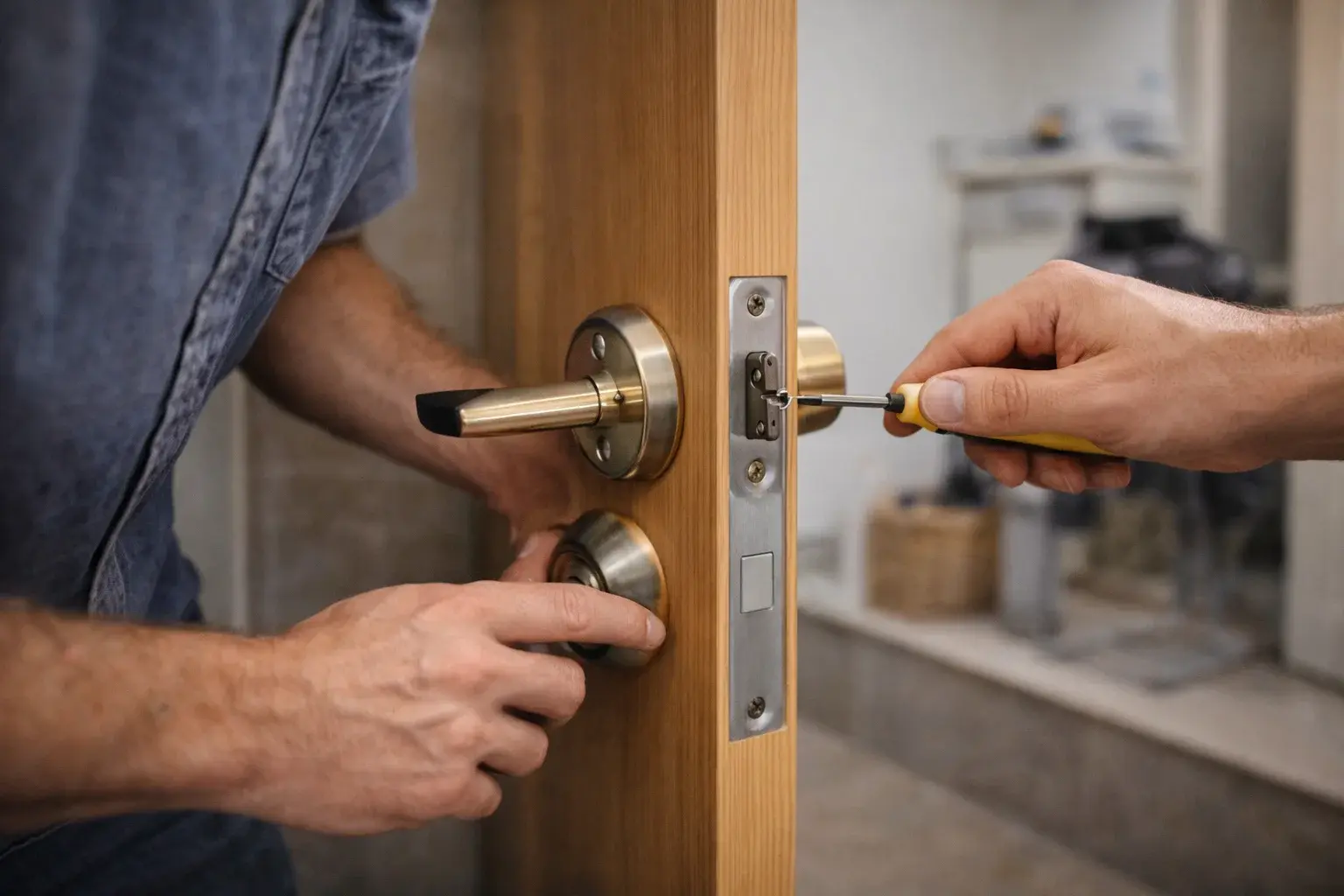
A practical door lock replacement decision starts with the affected item, its condition and the surrounding materials. Replace suitable ordinary mechanical hardware in the compatible existing preparation and check its operation with the authorised customer.
Signs: the latch, handle, hinge or ordinary running hardware no longer lines up or operates normally or the door sags, rubs, sticks or has uneven gaps around the opening. Causes: loose fixings, minor alignment drift or ordinary timber movement or local damage to an accessible component rather than an assumed structural defect.
Hardware must suit the leaf thickness and the maker’s permitted range. Spindles and fixings are not interchangeable solely because the finish matches. Provide the door specification where possible and keep the complete supplied pack together until the fit is reviewed.
Check the accepted mechanical hardware with the door open and then in its ordinary closed position. The authorised customer should understand the supplied product’s operation. This is a fitting check, not a security assessment, compliance certificate or promise against unauthorised entry.
Keep supplied instructions and keys secure. Refer key cutting, rekeying, lockouts and specialist security requirements to an appropriate provider. Limits: Authorised ordinary compatible mechanical lockset replacement only. No lockouts, emergency entry, key cutting, rekeying, locksmith security services, rated-door work or electrical integration.